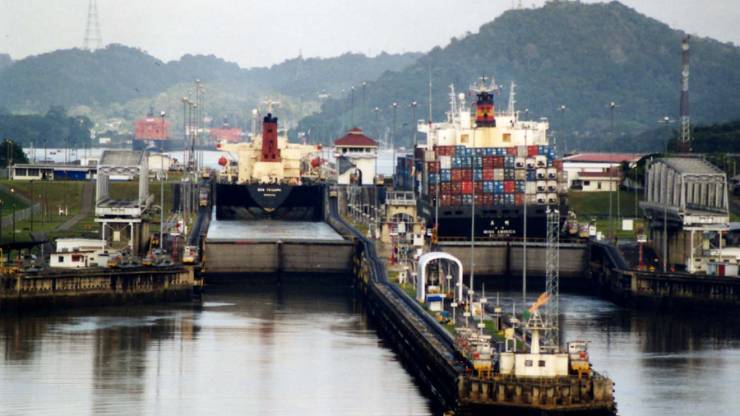
Amid what is being referred to as the most dire traffic congestion in maritime history, approximately 200 cargo vessels are currently held in a standstill at the Panama Canal. This predicament arises from the adverse effects of global climate change, which have plunged the region into its severest drought in a century. As per Futurism’s reportage, the substantial backlog of ships has been steadily escalating and is unlikely to alleviate for several weeks to come. Renowned not only for its remarkable engineering achievements but also as one of the paramount trade passages on Earth, the man-made conduit finds itself ensnared in a historic dilemma.
A historic drought has precipitated the creation of an unparalleled maritime traffic gridlock at the Panama Canal, with a staggering 200 ships vying to traverse its waters.
The Panama Canal heavily relies on copious water reserves, the availability of which has dwindled considerably during the ongoing drought. The continuum of global climate change is manifesting in the escalation of extreme weather events and conditions, including droughts, floods, and hurricanes, with heightened frequency and intensity. This occurrence is far from unprecedented; the canal has grappled with water scarcities in recent history.
Notably absent over the majority of the past century, droughts at the Panama Canal are now becoming an unfortunate reality due to the transforming impact of climate change. This shift comes at the expense of a more favorable and economical scenario. As recent as 2019, analogous conditions to the current dry spell have plagued Panama, a region that historically ranks amongst the world’s wettest locales. Prior to that, 2016 also witnessed parched conditions, each event surpassing the severity of its predecessor.
The prevailing maritime congestion at the Panama Canal emerges two years after a single vessel managed to obstruct the Suez Canal for an extended period, precipitating global shipping pandemonium.
Collectively, these weather conditions have remained uncommon within the annals of Panama Canal history, with the most recent drought of such magnitude tracing back a century. Nevertheless, the shifting global climate continually exacerbates such circumstances. The existing backlog of around 200 vessels is already triggering a ripple effect that will cast ripples through businesses, residences, and communities reliant on the daily passage of essential supplies and commodities through this waterway.
Stretching across a length of 50 miles, the Panama Canal is sustained by indigenous rainfall, rendering a deficiency of precipitation as a driving force for canal authorities to curtail water consumption and consequently, maritime traffic.
Employing locks at both termini, these locks fill with water to elevate ships from oceanic water levels to the elevation of the artificial Gatun Lake, situated 85 feet above sea level, before lowering them back to sea level at the opposing terminus. This intricate process necessitates copious water reserves, now imperiled due to the impacts of climate change, even altering the colors of the surrounding oceans.
Operating at maximum capacity demands an excess of 50 million gallons of water daily, rendering a climate change-induced water shortage a harbinger of diminished maritime traffic. Consequently, conservation efforts correlate with heightened fees levied on cargo vessels traversing this passage. Currently capped at 32 ships per day, the canal experiences a reduction of four ships daily from its typical cap of approximately 36.
While this decrement may seem minor, the constricted flow has culminated in an escalating number of vessels languishing in wait to navigate the Panama Canal. The tally has surpassed 200, with the average wait time for passage stretching to approximately 20 days. As the drought exacerbates, Ricaurte Vásquez Morales, the canal’s administrator, disclosed during a recent press conference that these restrictions may endure through the entirety of 2023, which, in turn, is anticipated to incur revenue losses of an estimated $200 million. Such is the toll of persistent climate change.
“In the absence of adaptation,” Morales asserts, “our fate is sealed.” This adage resonates not only for the Panama Canal but for our planet at large.