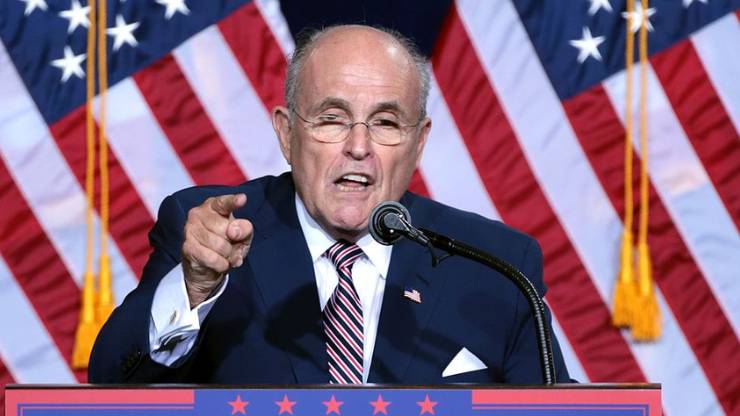
Donald Trump asserts his dedication to loyalty, yet his track record reveals a penchant for neglecting those who serve him. The question arises: does he prioritize loyalty or stinginess? Regrettably for Rudy Giuliani, it’s the latter that prevails.
Rudy Giuliani, the former mayor of New York, finds himself ensnared in an escalating web of legal predicaments stemming from his endeavors to tilt the 2020 election in Trump’s favor while functioning as his personal attorney. These efforts have led him into the crosshairs of multiple defamation lawsuits and now criminal charges in Georgia. (It’s worth noting that he’s also facing a separate lawsuit related to alleged sexual assault, though it has no connection to Trump.)
This week, Giuliani’s legal team, representing him in a defamation case filed by Smarmatic, a voting technology company, acknowledged that he is essentially financially strained. However, they’ve declined to provide a comprehensive financial breakdown, arguing that doing so would merely “embarrass Mr. Giuliani and draw attention to his misfortunes.” A rough estimate by CNN sheds light on the extent of Giuliani’s financial woes, amounting to hundreds of thousands of dollars.
During a court session on Monday, Giuliani, the former mayor of New York City, admitted that the entanglement of legal woes has left him financially drained. In response to this financial crunch, he has even opted to list a three-bedroom Manhattan apartment he owns for a hefty $6.5 million.
Excluding standard legal fees, Giuliani is confronted with nearly $90,000 in sanctions issued by a judge in a defamation case, a monthly fee of $20,000 paid to a company for hosting his electronic records, expenditures exceeding $15,000 for record searches, and an outstanding judgment of $57,000 against his company due to unpaid phone bills.
“These are substantial bills that he is failing to address,” stated attorney Adam Katz in a New York courtroom on Wednesday. “This situation is proving to be quite humbling for Mr. Giuliani.”
With his law license suspended due to his efforts to bolster Trump’s grip on power, Giuliani now derives income solely from his radio show and certain podcast engagements, as reported by The New York Times. His annual earnings amount to around $400,000 from his WABC radio show. Additionally, he receives income from hosting a podcast and a livestream broadcast. However, these financial streams fall far short of covering his mounting debts. Notably, a legal defense fund established by supporters to raise $5 million in 2021 for his legal expenses shuttered its website after managing to raise less than $10,000.
Curiously, Giuliani’s financial predicament prompted him to personally approach Trump for assistance earlier this year. As reported by CNN, in the spring, he traveled to Mar-a-Lago alongside his attorney Robert Costello, aiming to secure Trump’s aid. The purpose was to discuss Giuliani’s substantial legal bills, emphasizing how Trump’s support was in his own best interest. However, the notoriously parsimonious former president exhibited limited enthusiasm. Following Costello’s presentation, Trump tentatively agreed to contribute to some of Giuliani’s legal costs, though he refrained from specifying the exact amount or timeline.
Interestingly, Trump’s reluctance to cover Giuliani’s expenses is compounded by his willingness to finance legal fees for co-defendants in the classified-documents case: Mar-a-Lago property manager Carlos De Oliveira and former Diet Coke valet Walt Nauta. Federal records disclose that the Save America PAC allocated $21.6 million towards legal expenditures for Trump and his associates in the first half of 2023, constituting roughly two-thirds of the PAC’s total spending during that period.
In retrospect, it appears that Trump eventually offered only a fraction of the assistance required to alleviate Giuliani’s debt burden, and the funds were not drawn from his personal resources. Months after Giuliani’s appeal, Trump’s Save America PAC disbursed $340,000 to a data vendor hosting Giuliani’s former attorney’s records, as per CNN’s findings.
In more recent developments, Giuliani’s son took it upon himself to appeal to Trump. The New York Times reported that Andrew Giuliani, maintaining an independent rapport with the former president, visited Trump in New Jersey with the hope of securing financial support to offset his father’s substantial legal bills. This intervention yielded results. Andrew Giuliani requested that Trump participate in two fundraisers to assist with the legal expenses, and Trump agreed to the proposition.
In fact, Giuliani and his supporters have spent years urging Trump to cover his legal costs, arguing that this is the least Trump could do considering Giuliani’s pro bono legal work on his behalf. Trump, however, has remained resolute in his refusal to remunerate Giuliani for his legal services, and intriguingly, he hasn’t conveyed the rationale behind this decision to Giuliani. The New York Times reported that Trump has pointed out Giuliani’s string of legal losses related to the election. This sentiment echoes Trump’s stance shortly after Election Day when an associate of Giuliani’s, Maria Ryan, requested $20,000 per day from the campaign to cover Giuliani’s efforts. While Giuliani’s allies contend that his work extended beyond lawsuits to encompass research and attempts to prevent state legislatures from certifying election results he deemed erroneous, Trump purportedly stated that he wouldn’t provide compensation unless Giuliani achieved success. Although some of Giuliani’s expenses were eventually covered, the funds were only released after Trump personally authorized their disbursement.
Trump’s refusal to remunerate Giuliani could potentially prove counterproductive, as it heightens the likelihood of Giuliani cooperating with federal and state prosecutors pursuing charges against Trump. According to CNN, those close to Trump find his stance unwise, drawing parallels to how his relationship with Michael Cohen deteriorated during the latter’s investigation by special counsel Robert Mueller.
Michael Cohen’s insights shed light on Trump’s possibly self-defeating refusal to financially assist Giuliani. Cohen, once Trump’s fixer turned adversary, stated on MSNBC that Giuliani’s chances of obtaining payment from Trump are slimmer than the odds of him propelling himself to the moon using a slingshot. Cohen explained that Giuliani seems to view it as an honor and privilege to undergo legal repercussions on Trump’s behalf, serving as his enforcer for unsavory tasks.